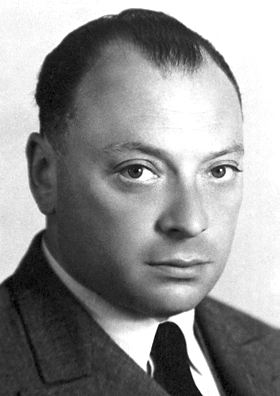
Wolfgang Pauli (1900)
Wolfgang Ernst Pauli ( PAW-lee; German: [ˈpaʊ̯li] ; 25 April 1900 – 15 December 1958) was an Austrian–Swiss theoretical physicist and a pioneer of quantum mechanics.
Commentary
Commentary
Wolfgang Pauli (1900)
Wolfgang Ernst Pauli ( PAW-lee; German: [ˈpaʊ̯li] ; 25 April 1900 – 15 December 1958) was an Austrian–Swiss theoretical physicist and a pioneer of quantum mechanics.
Why is Wolfgang Pauli remembered?
Every major advance in physics was made by a person working to understand something that didn't quite make sense yet. Wolfgang Pauli was one of those people.
About Wolfgang Pauli
Wolfgang Ernst Pauli ( PAW-lee; German: [ˈpaʊ̯li] ; 25 April 1900 – 15 December 1958) was an Austrian–Swiss theoretical physicist and a pioneer of quantum mechanics. In 1945, after having been nominated by Albert Einstein, Pauli received the Nobel Prize in Physics "for the discovery of the Exclusion Principle, also called the Pauli Principle". The discovery involved spin theory, which is the basis of a theory of the structure of matter.
To preserve the conservation of energy in beta decay, Pauli proposed the existence of a small neutral particle, dubbed the neutrino by Enrico Fermi, in 1930. Neutrinos were first detected in 1956.
Sources: Wikipedia
FREE DAILY EMAIL
Get it in your inbox
One short, ad-free email each morning. Always free, unsubscribe anytime.
Commentary
Commentary