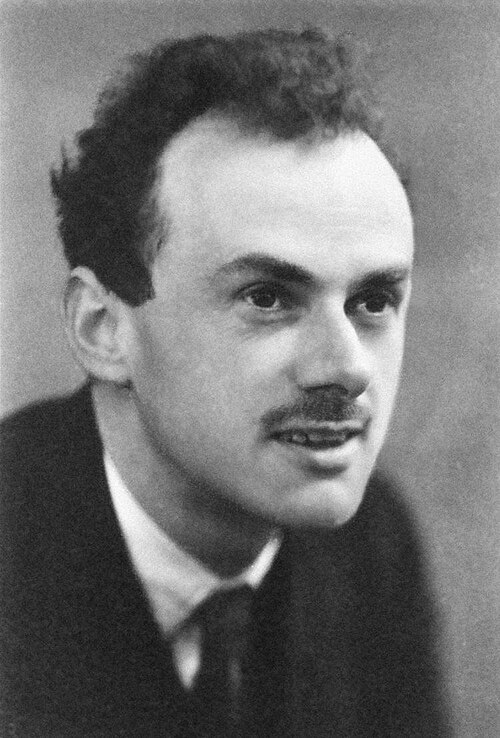
Paul Dirac (1902)
Paul Adrien Maurice Dirac ( dih-RAK; 8 August 1902 – 20 October 1984) was a British theoretical physicist who is considered to be one of the founders of quantum mechanics.
Commentary
Commentary
Paul Dirac (1902)
Paul Adrien Maurice Dirac ( dih-RAK; 8 August 1902 – 20 October 1984) was a British theoretical physicist who is considered to be one of the founders of quantum mechanics.
Why is Paul Dirac remembered?
Every major advance in physics was made by a person working to understand something that didn't quite make sense yet. Paul Dirac was one of those people.
About Paul Dirac
Paul Adrien Maurice Dirac ( dih-RAK; 8 August 1902 – 20 October 1984) was a British theoretical physicist who is considered to be one of the founders of quantum mechanics. Dirac laid the foundations for both quantum electrodynamics and quantum field theory, coining the former term. He was the Lucasian Professor of Mathematics at the University of Cambridge from 1932 to 1969, and a professor of physics at Florida State University from 1970 to 1984. Dirac shared the 1933 Nobel Prize in Physics with Erwin Schrödinger "for the discovery of new productive forms of atomic theory."
Dirac graduated from the University of Bristol with a First Class Honours Bachelor of Science degree in electrical engineering in 1921, and a first class honours Bachelor of Arts degree in mathematics in 1923. Dirac then graduated from St John's College, Cambridge, with a Ph.D. in physics in 1926, writing the first ever thesis on quantum mechanics.
He formulated the Dirac equation, one of the most important results in physics, in 1928. It connected special relativity and quantum mechanics and predicted the existence of antimatter. He wrote a famous paper in 1931, which further predicted the existence of antimatter. Dirac also contributed greatly to the reconciliation of general relativity with quantum mechanics. He contributed to Fermi–Dirac statistics, which describes the behaviour of fermions, particles with half-integer spin. His 1930 monograph, The Principles of Quantum Mechanics, is one of the most influential texts on the subject. He and Schrödinger tied for eighth in a Physics World poll of the greatest physicists of all time.
In 1987, Abdus Salam declared that "Dirac was undoubtedly one of the greatest physicists of this or any century ... No man except Einstein has had such a decisive influence, in so short a time, on the course of physics in this century." In 1995, Stephen Hawking stated that "Dirac has done more than anyone this century, with the exception of Einstein, to advance physics and change our picture of the universe" while Stanley Deser remarked that "We all stand on Dirac's shoulders."
Sources: Wikipedia
FREE DAILY EMAIL
Get it in your inbox
One short, ad-free email each morning. Always free, unsubscribe anytime.
Commentary
Commentary