Physics: Louis de Broglie
Physics: Louis de Broglie
Wikimedia Commons, CC BY-SA
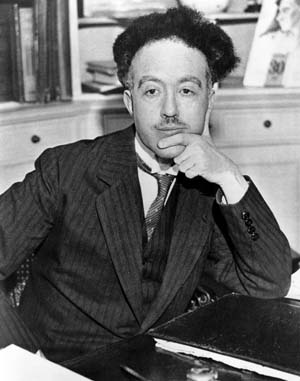
Louis de Broglie (1892) Louis Victor Pierre Raymond, 7th Duc de Broglie (French: [də bʁɔj] ; 15 August 1892 – 19 March 1987) was a French theoretical physicist and aristocrat known for his contributions to quantum theory.

Commentary

Commentary

Louis de Broglie (1892) Louis Victor Pierre Raymond, 7th Duc de Broglie (French: [də bʁɔj] ; 15 August 1892 – 19 March 1987) was a French theoretical physicist and aristocrat known for his contributions to quantum theory.

Commentary

Why is Louis de Broglie remembered? Ev ery major advance in physics was made by a person working to understand something that didn't quite make sense yet. Louis de Broglie was one of those people.

Commentary

About Louis de Broglie Louis Victor Pierre Raymond, 7th Duc de Broglie (French: [də bʁɔj] ; 15 August 1892 – 19 March 1987) was a French theoretical physicist and aristocrat known for his contributions to quantum theory. In his 1924 Ph.D. thesis, de Broglie postulated the wave nature of electrons and suggested that all matter has wave properties. This concept is kn own as the de Broglie hypothesis, an example of wave–particle duality, and forms a central part of the theory of quantum mechanics. In 1929, de Broglie won the Nobel Prize in Physics, after the wave-like behaviour of matter was experimentally confirmed in 1927. This confirmation earned George Paget Thomson and Clinton Davisson the Nobel in 1937. The wave-like behaviour of particles theorized by de Broglie was used by Erwin Schrödinger in his formulation of wave mechanics. De Broglie presented an alternative interpretation of these mechanics called the pilot-wave concept at the 1927 Solvay Conferences, but then abandoned it. In 1952, David Bohm developed a new form of the concept which became known as the de Broglie–Bohm theory. De Broglie revisited the idea in 1956, creating another version that incorporated ideas from Bohm and Jean-Pierre Vigier. Louis de Broglie was the sixteenth member elected to occupy seat 1 of the Académie française in 1944, and served as Perpetual Secretary of the French Academy of Sciences. De Broglie became the first high-level scientist to call for establishment of a multi-national laboratory, a proposal that led to the establishment of the European Organization for Nuclear Research (CERN). Among his publications were The Revolution in Physics and Matter and Light. He was honorary president of the French Association of Science Writers and received the inaugural Kalinga Prize from UNESCO for his efforts to popularize science.