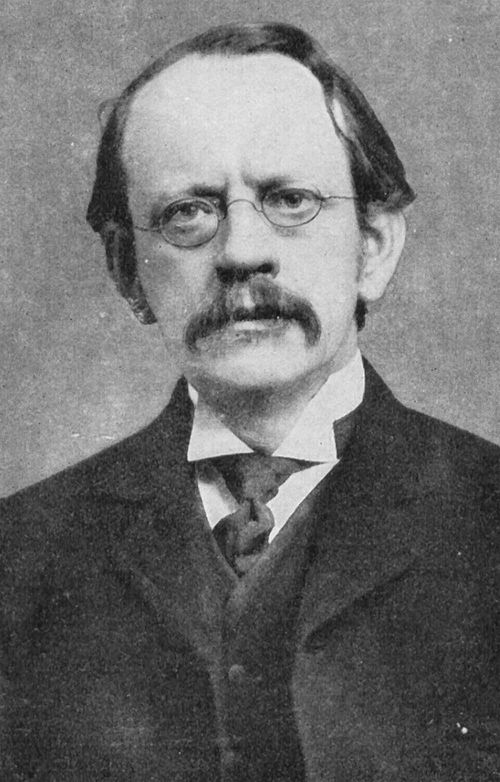
J. J. Thomson (1856)
Sir Joseph John Thomson (18 December 1856 – 30 August 1940) was a British physicist.
Commentary
Commentary
J. J. Thomson (1856)
Sir Joseph John Thomson (18 December 1856 – 30 August 1940) was a British physicist.
Why is J. J. Thomson remembered?
Every major advance in physics was made by a person working to understand something that didn't quite make sense yet. J. J. Thomson was one of those people.
About J. J. Thomson
Sir Joseph John Thomson (18 December 1856 – 30 August 1940) was a British physicist. He received the 1906 Nobel Prize in Physics "in recognition of the great merits of his theoretical and experimental investigations on the conduction of electricity by gases." In 1897, he showed that cathode rays were composed of previously unknown negatively charged particles (now called electrons), which he calculated must have bodies much smaller than atoms and a very large charge-to-mass ratio. The electron was the first subatomic particle to be discovered.
Thomson is credited with finding the first evidence for isotopes of a stable (non-radioactive) element in 1912, as part of his exploration into the composition of canal rays (positive ions). His experiments to determine the nature of positively charged particles, with Francis William Aston, were the first use of mass spectrometry and led to the development of the mass spectrograph.
Thomson was an influential teacher, and seven of his students went on to win Nobel Prizes: Ernest Rutherford (Chemistry 1908), Lawrence Bragg (Physics 1915), Charles Barkla (Physics 1917), Francis Aston (Chemistry 1922), Charles Thomson Rees Wilson (Physics 1927), Owen Richardson (Physics 1928) and Edward Appleton (Physics 1947). His son, George Paget Thomson, shared the 1937 Nobel Prize in Physics with Clinton Davisson "for their experimental discovery of the diffraction of electrons by crystals".
Sources: Wikipedia
FREE DAILY EMAIL
Get it in your inbox
One short, ad-free email each morning. Always free, unsubscribe anytime.
Commentary
Commentary