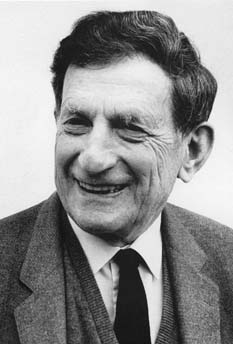
Physics: David Bohm

Physics: David Bohm
Wikimedia Commons, CC BY-SA
David Bohm (1917) David Joseph Bohm (; 20 December 1917 – 27 October 1992) was an American physicist who has been described as one of the most significant theoretical physicists of the 20th century and who contributed unorthodox ideas to quantum theory, neuropsychology and the philosophy of mind.

Commentary

Commentary

David Bohm (1917) David Joseph Bohm (; 20 December 1917 – 27 October 1992) was an American physicist who has been described as one of the most significant theoretical physicists of the 20th century and who contributed unorthodox ideas to quantum theory, neuropsychology and the philosophy of mind.

Commentary

Why is David Bohm remembered? Every major advance in physics was made by a person working to understand something that didn't quite make sense yet. David Bohm was one of those people.

Commentary

About David Bohm David Joseph Bohm (; 20 December 1917 – 27 October 1992) was an American physicist who has been described as one of the most significant theoretical physicists of the 20th century and who contributed unorthodox ideas to quantum theory, neuropsychology and the philosophy of mind. Among his many contributions to physics is his causal and determin istic interpretation of quantum theory known as De Broglie–Bohm theory. Bohm advanced the view that quantum physics meant that the old Cartesian model of reality—that there are two kinds of substance, the mental and the physical, that somehow interact—was too limited. To complement it, he developed a mathematical and physical theory of "implicate" and "explicate" order. He also believed that the brain, at the cellular level, works according to the mathematics of some quantum effects, and postulated that thought is distributed and non-localised just as quantum entities are. Bohm's main concern was with understanding the nature of reality in general and of consciousness in particular as a coherent whole, which according to Bohm is never static or complete. Bohm warned of the dangers of rampant reason and technology, advocating instead the need for genuine supportive dialogue, which he claimed could bridge and unify conflicting and troublesome divisions in the social world. Born in the United States, Bohm obtained his Ph.D. under J. Robert Oppenheimer at the University of California, Berkeley. Due to his Communist affiliations, he was the subject of a federal government investigation in 1949, leading to his suspension from Princeton University and prompting him to leave the U.S. He pursued his career in several countries, becoming first a Brazilian and then a British citizen. He abandoned Marxism in the wake of the Hungarian Uprising in 1956.