First law of thermodynamics
The first law of thermodynamics is a formulation of the law of conservation of energy in the context of thermodynamic processes.
Commentary
Commentary
First law of thermodynamics
The first law of thermodynamics is a formulation of the law of conservation of energy in the context of thermodynamic processes.
Why does First law of thermodynamics matter?
This principle is one of the building blocks physicists use to explain the world. Without it, a whole class of phenomena would have no mathematical description. Engineers, chemists, and astronomers all rely on it.
Background: First law of thermodynamics
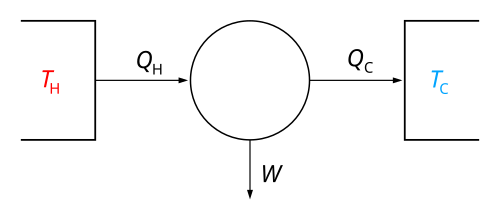
The first law of thermodynamics is a formulation of the law of conservation of energy in the context of thermodynamic processes. For a thermodynamic process affecting a thermodynamic system without transfer of matter, the law distinguishes two principal forms of energy transfer, heat and thermodynamic work. The law also defines the internal energy of a system, an extensive property for taking account of the balance of heat transfer, thermodynamic work, and matter transfer, into and out of the system. Energy cannot be created or destroyed, but it can be transformed from one form to another. In an externally isolated system, with internal changes, the sum of all forms of energy is constant.
An equivalent statement is that perpetual motion machines of the first kind are impossible; work done by a system on its surroundings requires that the system's internal energy be consumed, so that the amount of internal energy lost by that work must be resupplied as heat by an external energy source or as work by an external machine acting on the system to sustain the work of the system continuously.
Sources: Wikipedia
FREE DAILY EMAIL
Get it in your inbox
One short, ad-free email each morning. Always free, unsubscribe anytime.
Commentary
Commentary