Torque
In physics and mechanics, torque is the rotational correspondent of linear force.
Commentary
Commentary
Torque
In physics and mechanics, torque is the rotational correspondent of linear force.
What is Torque, and why does it matter?
This concept appears everywhere in physics. Once you understand it, a wide range of natural phenomena start to make sense.
Deep dive: Torque
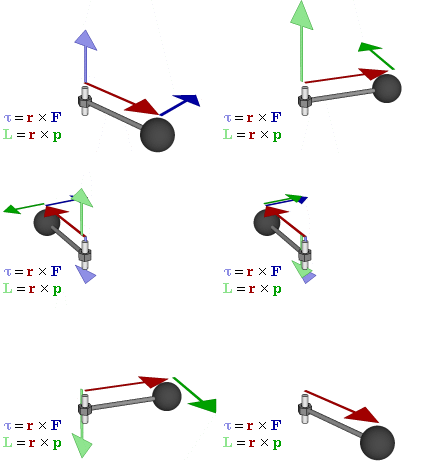
In physics and mechanics, torque is the rotational correspondent of linear force. It is also referred to as the moment of force, or simply the moment. Just as a linear force is a push or a pull applied to a body, a torque can be thought of as a twist applied to an object with respect to a chosen axis. For example, driving a screw uses torque to force it into an object. The torque is applied by the screwdriver, rotating around its axis, to the drive on the head of the screw.
Torque is generally referred to using different vocabulary depending on geographical location and field of study, with torque generally being associated with physics and moment being associated with engineering. This article follows the definition used in US physics in its usage of the word torque.
Torque is typically represented mathematically using the lowercase Greek letter tau (
τ
{\displaystyle {\boldsymbol {\tau }}}
). When being referred to as moment of force, it is commonly denoted by M.
Sources: Wikipedia
FREE DAILY EMAIL
Get it in your inbox
One short, ad-free email each morning. Always free, unsubscribe anytime.
Commentary
Commentary