Physics: Standard Model
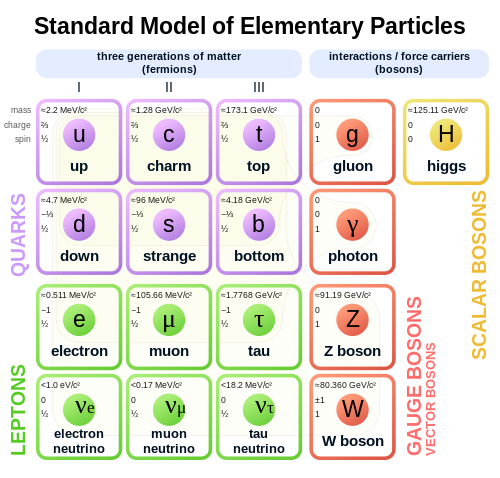
Physics: Standard Model
Wikimedia Commons, CC BY-SA
Standard Model The Standard Model of particle physics is the theory describing three of the four known fundamental forces (electromagnetic, weak and strong interactions – excluding gravity) in the universe and classifying all known elementary particles.

Commentary

Commentary

Standard Model The Standard Model of particle phys ics is the theory describing three of the four known fundamental forces (electromagnetic, weak and strong interactions – excluding gravity) in the universe and classifying all known elementary particles.

Commentary

What is Standard Model, and why do es it matter? This concept appears everywhere in physics. Once you understand it, a wide range of natural phenomena start to make sense.

Commentary

Deep dive: Standard Model The Standard Model of particle physics is the theory describing three of the four known fundamental forces (electromagnetic, weak and strong interactions – excluding gravity) in the universe and classifying all known elementary particles. It was developed in stages throughout the latter half of the 20th century, through the work of many scientists worldwide, with the current formulation being finalized in the mid-1970 s upon experimental confirmation of the existence of quarks. Since then, proof of the top quark (1995), the tau neutrino (2000), and the Higgs boson (2012) have added further credence to the Standard Model. In addition, the Standard Model has predicted with great accuracy the various properties of weak neutral currents and the W and Z bosons. Although the Standard Model is believed to be theoretically self-consistent and has demonstrated some success in providing experimental predictions, it leaves some physical phenomena unexplained and so falls short of being a complete theory of fundamental interactions. For example, it does not fully explain why there is more matter than anti-matter, incorporate the full theory of gravitation as described by general relativity, or account for the universe's accelerating expansion as possibly described by dark energy. The model does not contain any viable dark matter particle that possesses all of the required properties deduced from observational cosmology. The Standard Model without modifications also does not incorporate neutrino oscillations and their non-zero masses, but extensions have been proposed that can account for these features. The development of the Standard Model was driven by theoretical and experimental particle physicists alike. The Standard Model is a paradigm of a quantum field theory for theorists, exhibiting a wide range of phenomena, including spontaneous symmetry breaking, anomalies, and non-perturbative behavior. It is used as a basis for building more exotic models that incorporate hypothetical particles, extra dimensions, and elaborate symmetries (such as supersymmetry) to explain experimental results at variance with the Standard Model, such as the existence of dark matter and neutrino oscillations.