Magnetic field
In electromagnetism, magnetic field is a physical property of space that quantifies the magnetic strength at a given location.
Commentary
Commentary
Magnetic field
In electromagnetism, magnetic field is a physical property of space that quantifies the magnetic strength at a given location.
What is Magnetic field, and why does it matter?
This concept appears everywhere in physics. Once you understand it, a wide range of natural phenomena start to make sense.
Deep dive: Magnetic field
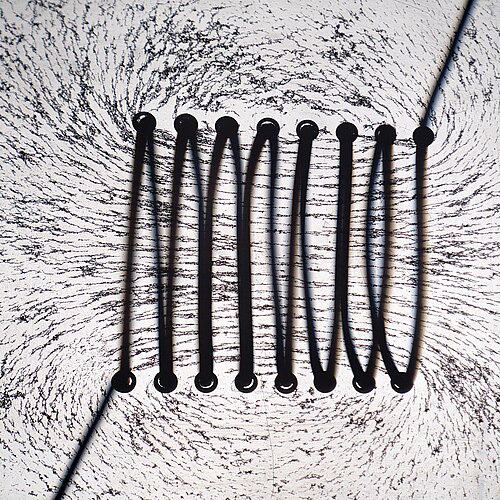
In electromagnetism, magnetic field is a physical property of space that quantifies the magnetic strength at a given location. Magnetic fields deflect moving electric charges (including electric currents), apply torques on magnets to twist them in the direction of the magnetic field, and attract or repel magnets and magnetic material such as iron. In addition, a time varying magnetic field induces electrical currents.
Magnetic fields are created by magnetic materials and by moving electric charges (including electrical current). The latter is important in creating electromagnets: devices that precisely control magnetic fields by changing the current through the electromagnet.
Since both strength and direction of a magnetic field may vary with location, it is described mathematically by assigning a vector to each point of space, making it a vector field.
Magnetic fields are used throughout modern science and technology. In electrical engineering and electromechanics it is important in the design and use of electric motors, generators, transformers, electromagnets, and inductors among many other devices. In material science, magnetic forces give information about the charge carriers in a material through the Hall effect in addition to other uses. In geology and geophysics, Earth's magnetic field gives information about earth's interior while local magnetic field measurements are used in mineral exploration and other measurements. In astronomy, magnetic fields are produced by many astronomical objects including planets, stars, white dwarfs, neutron stars, etc. Too, Earth's magnetic field creates a magnetosphere which shields the Earth's ozone layer and the rest of the planet from the solar wind. In physics the relationship between the magnetic and electric fields forms the field of electrodynamics which is important to understand a wide range of phenomena including light (also known as electromagnetic radiation) and the properties of antenna and transmission lines.
Sources: Wikipedia
FREE DAILY EMAIL
Get it in your inbox
One short, ad-free email each morning. Always free, unsubscribe anytime.
Commentary
Commentary