July 19, 1983
The first three-dimensional reconstruction of a human head in a CT is published.
Commentary
Commentary
On July 19, in the year 1983:
The first three-dimensional reconstruction of a human head in a CT is published.
A computed tomography scan, formerly known in a more rudimentary state as computed axial tomography scan, is a medical imaging technique used to obtain detailed internal images of the body.
Why July 19, 1983 matters:
The first three-dimensional reconstruction of a human head in a CT is published.
What began on this day left a lasting mark on history. The effects were felt immediately and continued to shape events, ideas, and lives long afterwards.
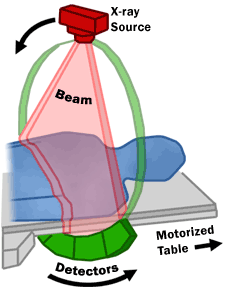
CT scanners use a rotating X-ray tube and a row of detectors placed in a gantry to measure X-ray attenuations by different tissues inside the body. The multiple X-ray measurements taken from different angles are then processed on a computer using tomographic reconstruction algorithms to produce tomographic (cross-sectional) images of a body. CT scans can be used in patients with metallic implants or pacemakers, for whom magnetic resonance imaging (MRI) is contraindicated.
Historical context: July 19, 1983
The 20th century brought rapid advances in health, communication, science, and technology that reshaped everyday human experience.
The event on this day: The first three-dimensional reconstruction of a human head in a CT is published.
CT scanners use a rotating X-ray tube and a row of detectors placed in a gantry to measure X-ray attenuations by different tissues inside the body. The multiple X-ray measurements taken from different angles are then processed on a computer using tomographic reconstruction algorithms to produce tomographic (cross-sectional) images of a body. CT scans can be used in patients with metallic implants or pacemakers, for whom magnetic resonance imaging (MRI) is contraindicated.
Source: https://en.wikipedia.org/wiki/CT_scan (Wikipedia, CC BY-SA)
Sources: Wikipedia (CC BY-SA)
FREE DAILY EMAIL
Get it in your inbox
One short, ad-free email each morning. Always free, unsubscribe anytime.
Commentary
Commentary