Astronomy: Trojan Asteroids
Astronomy: Trojan Asteroids
Wikimedia Commons, CC BY-SA
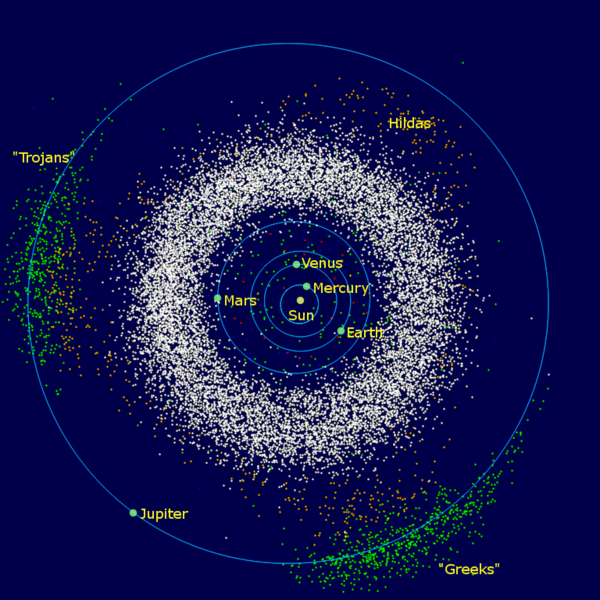
Trojan Asteroids The Jupiter trojans, commonly called trojan asteroids or simply trojans, are a large group of asteroids that share the planet Jupiter's orbit around the Sun. Relative to Jupiter, each trojan librates around one of Jupiter's stable Lagrange points: either L4, existing 60° ahead of the planet in its orbit, or L5, 60° behind.

Commentary

Commentary

Trojan Asteroids The Jupiter trojans, commonly called trojan asteroids or simply trojans, are a large group of asteroids that share the planet Jupiter's orbit around the Sun. Relative to Jupiter, each trojan librates around one of Jupiter's stable Lagrange points: either L4, existing 60° ahead of the planet in its orbit, or L5, 60° behind. Jupiter trojans are distributed in two elongated, curved regions around these Lagrangian points with an average semi-major axis of about 5.2 AU.

Commentary

Why Trojan Asteroids matters: These foundational ideas and techniques are the tools astronomers use to measure, classify, and understand everything from nearby planets to the most distant galaxies. The first Jupiter trojan discovered, 588 Achilles, was spotted in 1906 by German astronomer Max Wolf. More than 15,300 Jupiter trojans have been found as of October 2025. By convention, they are each named from Greek mythology after a figure of the Trojan War, hence the name "trojan". The total number of Jupiter trojans larger than 1 km in diameter is believed to be about 1 million, approximately equal to the number of asteroids larger than 1 km in the asteroid belt. Like main-belt asteroids, Jupiter trojans form families. As of 2004, many Jupiter trojans showed to observational instruments as dark bodies with reddish, featureless spectra. No firm evidence of the presence of water, or any other specific compound on their surface has been obtained, but it is thought that they are coated in tholins, organic polymers formed by the Sun's radiation. The Jupiter trojans' densities (as measured by studying binaries or rotational lightcurves) vary from 0.8 to 2.5 g·cm−3. Jupiter trojans are thought to have been captured into their orbits during the early stages of the Solar System's formation or slightly later, during the migration of giant planets. The term "Trojan Asteroid" specifically refers to the asteroids co-orbital with Jupiter, but the general term "trojan" is sometimes more generally applied to other small Solar System bodies with similar relationships to larger bodies: Mars trojans, Neptune trojans, Uranus trojans and Earth trojans are known to exist. Temporary Venus trojans and Saturn trojans exist, as well as for 1 Ceres and 4 Vesta. The term "Trojan asteroid" is normally understood to specifically mean the Jupiter trojans because the first Trojans were discovered near Jupiter's orbit and Jupiter currently has by far the most known Trojans.

Commentary

Deep dive: Trojan Asteroids More than 15,300 Jupiter trojans have been found as of October 2025. By convention, they are each named from Greek mythology after a figure of the Trojan War, hence the name "trojan". The total number of Jupiter trojans larger than 1 km in diameter is believed to be about 1 million, approximately equal to the number of aster oids larger than 1 km in the asteroid belt. Like main-belt asteroids, Jupiter trojans form families. As of 2004, many Jupiter trojans showed to observational instruments as dark bodies with reddish, featureless spectra. No firm evidence of the presence of water, or any other specific compound on their surface has been obtained, but it is thought that they are coated in tholins, organic polymers formed by the Sun's radiation. The Jupiter trojans' densities (as measured by studying binaries or rotational lightcurves) vary from 0.8 to 2.5 g·cm−3. Jupiter trojans are thought to have been captured into their orbits during the early stages of the Solar System's formation or slightly later, during the migration of giant planets. The term "Trojan Asteroid" specifically refers to the asteroids co-orbital with Jupiter, but the general term "trojan" is sometimes more generally applied to other small Solar System bodies with similar relationships to larger bodies: Mars trojans, Neptune trojans, Uranus trojans and Earth trojans are known to exist. Temporary Venus trojans and Saturn trojans exist, as well as for 1 Ceres and 4 Vesta. The term "Trojan asteroid" is normally understood to specifically mean the Jupiter trojans because the first Trojans were discovered near Jupiter's orbit and Jupiter currently has by far the most known Trojans. Source: https://en.wikipedia.org/wiki/Jupiter_trojan (Wikipedia, CC BY-SA)