Astronomy: Titan

Astronomy: Titan
Wikimedia Commons, CC BY-SA
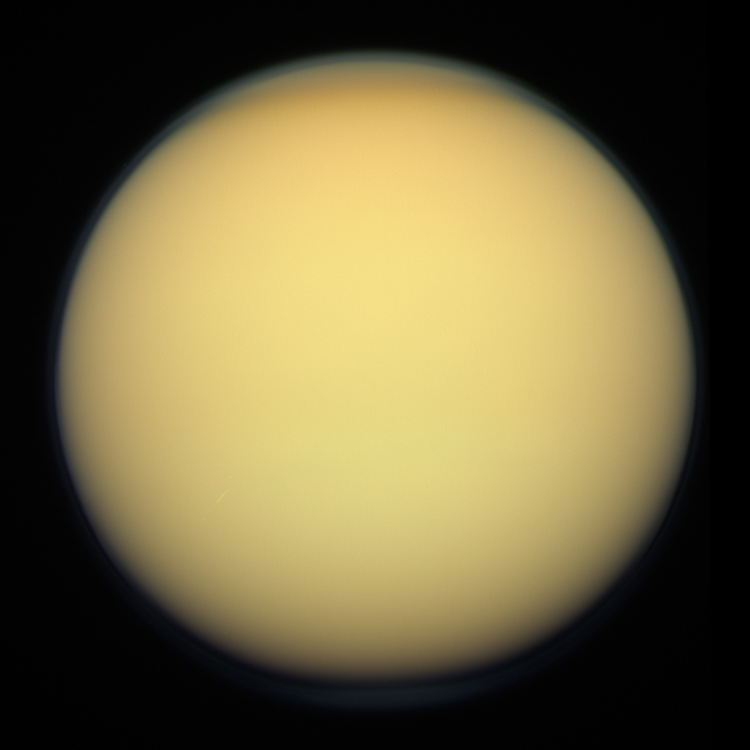
Titan Titan is the largest moon of Saturn and the second-largest in the Solar System. It is the only moon known to have a dense atmosphere—denser than Earth's—and is the only known object in the Solar System besides Earth with clear evidence of stable bodies of surface liquid.

Commentary

Commentary

Titan Titan is the largest moon of Saturn and the second-largest in the Sol ar System. It is the only moon known to have a dense atmosphere—denser than Earth's—and is the only known object in the Solar System besides Earth with clear evidence of stable bodies of surface liquid. Titan is one of seven gravitationally rounded moons of Saturn and the second-most distant among them.

Commentary

Why Titan matters: Understanding our cosmic neighbourhood helps us learn about planetary formation, the conditions for life, and ultimately our place in the universe. Frequently described as a planet-like moon, Titan is 48.16% larger in diameter than Earth's Moon and 80% more massive. It is the second-largest moon in the Solar System after Jupiter's Ganymede and is larger than Mercury; yet Titan is only 40% as massive as Mercury, because Mercury is mainly iron and rock while muc h of Titan is mostly ice, which is less dense. Discovered in 1655 by the Dutch astronomer Christiaan Huygens, Titan was the first known moon of Saturn and the sixth known planetary satellite (after Earth's moon and the four Galilean moons of Jupiter). Titan orbits Saturn at 20 Saturn radii or 1,200,000 km above Saturn's apparent surface. From Titan's surface, Saturn, disregarding its rings, subtends an arc of 5.09 degrees, and when viewed from above its thick atmospheric haze it would appear 11.4 times larger in the sky, in diameter, than the Moon from Earth, which subtends 0.48° of arc. Titan is primarily composed of ice and rocky material, with a rocky core surrounded by various layers of ice, including a crust of ice Ih and a subsurface layer of ammonia-rich liquid water. Much as with Venus before the Space Age, the dense opaque atmosphere prevented understanding of Titan's surface until the Cassini–Huygens mission in 2004 provided new information, including the discovery of liquid hydrocarbon lakes in Titan's polar regions and the discovery of its atmospheric super-rotation. The geologically young surface is generally smooth, with few impact craters, although mountains and several possible cryovolcanoes have been found. The atmosphere of Titan is mainly nitrogen and methane; minor components lead to the formation of hydrocarbon clouds and heavy organonitrogen haze. Its climate—including wind and rain—creates surface features similar to those of Earth, such as dunes, rivers, lakes, seas (probably of liquid methane and ethane), and deltas, and is dominated by seasonal weather patterns as on Earth. With its liquids (both surface and subsurface) and robust nitrogen atmosphere, Titan's methane cycle nearly resembles Earth's water cycle, albeit at a much lower temperature of about 94 K (−179 °C; −290 °F). Due to these factors, Titan is sometimes called the most Earth-like celestial object in the Solar System.

Commentary

Deep dive: Titan It is the second-largest moon in the Solar System after Jupiter's Ganymede and is larger than Mercury; yet Titan is only 40% as massive as Mercury, because Mercury is mainly iron and rock while much of Titan is mostly ice, which is less dense. Discovered in 1655 by the Dutch astronomer Christiaan Huygens, Titan was the first known moon of Saturn and the sixth known planetary satellite (after Earth's moon and the four Galile an moons of Jupiter). Titan orbits Saturn at 20 Saturn radii or 1,200,000 km above Saturn's apparent surface. From Titan's surface, Saturn, disregarding its rings, subtends an arc of 5.09 degrees, and when viewed from above its thick atmospheric haze it would appear 11.4 times larger in the sky, in diameter, than the Moon from Earth, which subtends 0.48° of arc. Titan is primarily composed of ice and rocky material, with a rocky core surrounded by various layers of ice, including a crust of ice Ih and a subsurface layer of ammonia-rich liquid water. Much as with Venus before the Space Age, the dense opaque atmosphere prevented understanding of Titan's surface until the Cassini–Huygens mission in 2004 provided new information, including the discovery of liquid hydrocarbon lakes in Titan's polar regions and the discovery of its atmospheric super-rotation. The geologically young surface is generally smooth, with few impact craters, although mountains and several possible cryovolcanoes have been found. The atmosphere of Titan is mainly nitrogen and methane; minor components lead to the formation of hydrocarbon clouds and heavy organonitrogen haze. Its climate—including wind and rain—creates surface features similar to those of Earth, such as dunes, rivers, lakes, seas (probably of liquid methane and ethane), and deltas, and is dominated by seasonal weather patterns as on Earth. With its liquids (both surface and subsurface) and robust nitrogen atmosphere, Titan's methane cycle nearly resembles Earth's water cycle, albeit at a much lower temperature of about 94 K (−179 °C; −290 °F). Due to these factors, Titan is sometimes called the most Earth-like celestial object in the Solar System. Source: https://en.wikipedia.org/wiki/Titan_(moon) (Wikipedia, CC BY-SA)