Astronomy: Ingenuity Helicopter
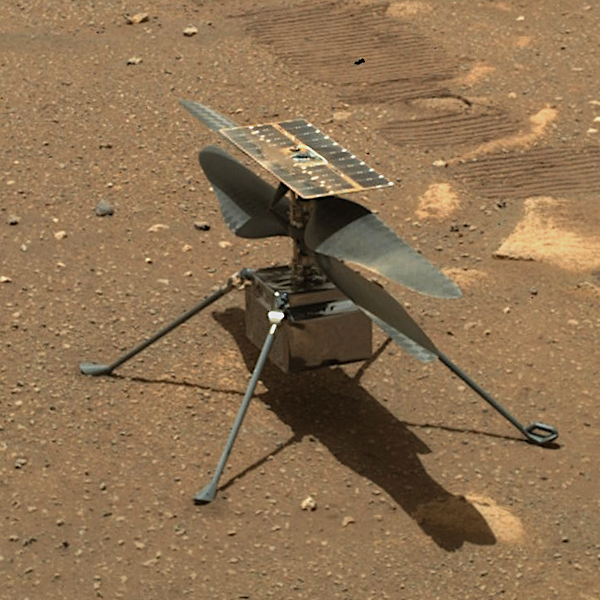
Astronomy: Ingenuity Helicopter
Wikimedia Commons, CC BY-SA
Ingenuity Helicopter Ingenuity, nicknamed Ginny, is an autonomous NASA helicopter that operated on Mars from 2021 to 2024 as part of the Mars 2020 mission. Ingenuity made its first flight on 19 April 2021, demonstrating that flight is possible in the extremely thin atmosphere of Mars, and became the first aircraft to conduct a powered and controlled extraterrestrial flight.

Commentary

Commentary

Ingenuity Helicopter Ingenuity, nicknamed Ginny, is an autonomous NASA helicopter that operated on Mars from 2021 to 20 24 as part of the Mars 2020 mission. Ingenuity made its first flight on 19 April 2021, demonstrating that flight is possible in the extremely thin atmosphere of Mars, and became the first aircraft to conduct a powered and controlled extraterrestrial flight. It was designed by NASA's Jet Propulsion Laboratory (JPL) in collaboration with AeroVironment, NASA's Ames Research Center and Langley Research Center with components supplied by Lockheed Martin Space, Qualcomm, and SolAero.

Commentary

Why Ingenuity Helicopter matters: Every mission and telescope pushes the boundary of what humanity can observe and understand. These instruments are our eyes and hands reaching into the cosmos. Ingenuity was delivered to Mars on 18 February 2021, attached to the underside of the Perseverance rover, which landed at the Octavia E. Butler Landing site near the western rim of the 45 km-wide (28 mi) Jezero crater. Because radio signals take several minutes to travel between Earth and Mars, it could not be manually controlled in real time, and instead autonomously flew flight plans sent to it by JPL. Originally intended to make only five flights, Ingenuity completed 72 flights in nearly three years. The five originally planned flights were part of a 30-sol technology demonstration intended to prove its airworthiness with flights of up to 90 seconds at altitudes ranging from 3–5 m (10–16 ft). Following this demonstration, JPL designed a series of operational flights to explore how aerial scouts could help explore Mars and other worlds. In this operational role, Ingenuity scouted areas of interest for the Perseverance rover, improved navigational techniques, and explored the limits of its flight envelope. Ingenuity's performance and resilience in the harsh Martian environment greatly exceeded expectations, allowing it to perform far more flights than were initially planned. On 18 January 2024, the rotor blades were broken during landing on flight 72, permanently grounding the helicopter. NASA announced the end of the mission one week later. Engineers concluded that Ingenuity's navigation system was not effective over the featureless terrain on the final flight, resulting in a crash landing. By the end of its mission, Ingenuity had flown for a total of two hours, eight minutes and 48 seconds over 1,004 days, covering more than 17 kilometres (11 mi).

Commentary

Deep dive: Ingenuity Helicopter Butler Landing site near the western rim of the 45 km-wide (28 mi) Jezero crater. Because radio signals take several minutes to travel between Earth and Mars, it could not be manually controlled in real time, and instead autonomously flew flight plans sent to it by JPL. Originally intended to make only five flights, Ingenuity completed 72 flights in nearly three years. The five originally planned flights were part of a 30-sol technology demonstration intended to prove its airworthiness with flights of up to 90 seconds at altitudes ranging from 3–5 m (10–16 ft). Following this demonstration, JPL designed a series of operational flights to explore how aerial scouts could help explore Mars and other worlds. In this operational role, Ingenuity scouted areas of interest for the Perseverance rover, improved navigational techniques, and explored the limits of its flight envelope. Ingenuity's performance and resilience in the harsh Martian environment greatly exceeded expectations, allowing it to perform far more flights than were initially planned. On 18 January 2024, the rotor blades were broken during landing on flight 72, permanently grounding the helicopter. NASA announced the end of the mission one week later. Engineers concluded that Ingenuity's navigation system was not effective over the featureless terrain on the final flight, resulting in a crash landing. By the end of its mission, Ingenuity had flown for a total of two hours, eight minutes and 48 seconds over 1,004 days, covering more than 17 kilometres (11 mi). Source: https://en.wikipedia.org/wiki/Ingenuity_(helicopter) (Wikipedia, CC BY-SA)