Astronomy: The H-R Diagram
Astronomy: The H-R Diagram
Wikimedia Commons, CC BY-SA
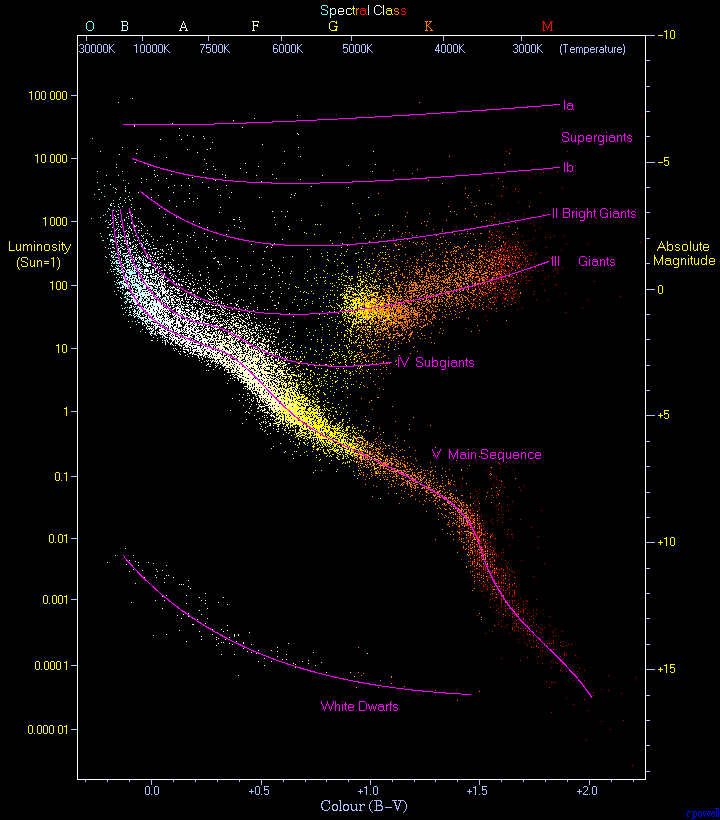
The H-R Diagram A Hertzsprung–Russell diagram (abbreviated as H–R diagram, HR diagram or HRD) is a scatter plot of stars showing the relationship between the stars' absolute magnitudes or luminosities and their stellar classifications or effective temperatures. It is also sometimes called a color magnitude diagram.

Commentary

Commentary

The H-R Diagram A Hertzsprung–Russell diagram (abbreviated as H–R diagram, HR diagram or HRD) is a scatter plot of stars showing the relationship between the stars' absolute magnitudes or luminosities and their stellar classifications or effective temperatures. It is also sometimes called a color magnitude diagram. The diagram was created independently in 1911 by Ejnar Hertzsprung and by Henry Norris Russell in 1913, and represented a major step towards an understanding of stellar evolution.

Commentary

Why The H-R Diagram matters: Stars are the engines of the cosmos -- they forge the chemical elements, light up galaxies, and create the conditions that make planets and life possible.

Commentary

Deep dive: The H-R Diagram The H-R Diag ram continues to be an active area of research in modern astronomy. Source: https://en.wikipedia.org/wiki/Hertzsprung%E2%80%93Russell_diagram (Wikipedia, CC BY-SA)