Astronomy: The Big Crunch
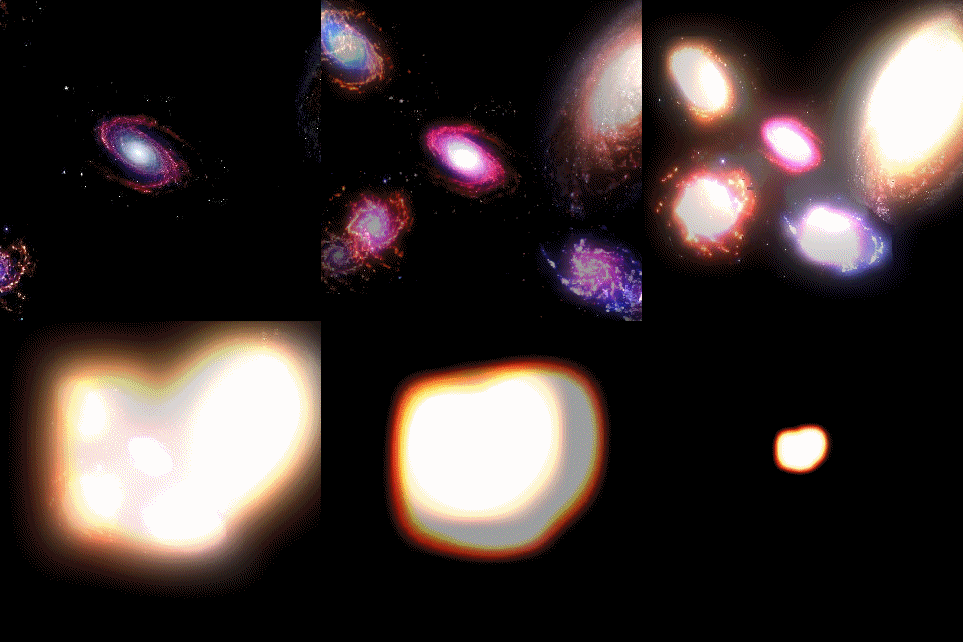
Astronomy: The Big Crunch
Wikimedia Commons, CC BY-SA
The Big Crunch The Big Crunch is a hypothetical scenario for the ultimate fate of the universe, in which the expansion of the universe eventually reverses and the universe recollapses, ultimately causing the cosmic scale factor to reach absolute zero, an event potentially followed by a reformation of the universe starting with another Big Bang. The vast majority of valid evidence, however, indicates that this hypothesis is not correct.

Commentary

Commentary

The Big Crunch The Big Crunch is a hypothetical scenario for the ultimate fate of the universe, in which the expansion of the universe eventually reverses and the universe recollapses, ultimately causing the cosmic scale factor to reach absolute zero, an event potentially followed by a reformation of the universe starting with another Big Bang. The vast majority of valid evidence, however, indicates that this hypothesis is not correct. Instead, astronomical observations show that the expansion of the universe is accelerating rather than being slowed by gravity, suggesting that a Big Chill or Big Rip is much more likely to occur.

Commentary

Why The Big Crunch matters: Cosmology addresses the deepest questions we can ask: where did the universe come from, what is it made of, and what will happen to it in the future? Nonetheless, some physicists have proposed th at a "Big Crunch-style" event could result from a dark energy fluctuation. The hypothesis dates back to 1922, with Russian physicist Alexander Friedmann creating a set of equations showing that the end of the universe depends on its density. It could either expand or contract rather than stay stable. With enough matter, gravity could stop the universe's expansion and eventually reverse it. This reversal would result in the universe collapsing on itself, not too dissimilar to a black hole. As the universe collapses in on itself, it would get filled with radiation from stars and high-energy particles; when this is condensed and blueshifted to higher energy, it would be intense enough to ignite the surface of stars before they collide. In the final moments, the universe would be one large fireball with a near-infinite temperature, and at the absolute end, neither time, nor space would remain.

Commentary

Deep dive: The Big Crunch The hypothesis dates back to 1922, with Russian physicist Alexander Friedmann creating a set of equations showing that the end of the universe depends on its density. It could either expand or contract rather than stay stable. With enough matter, gravity could stop the universe's expansion and eventually reverse it. This reversal would result in the universe collapsing on itself, not too dissimilar to a black hole. As the universe collapses in on itself, it would get filled with radiation from stars and high-energy particles; when this is condensed and blueshifted to higher energy, it would be intense enough to ignite the surface of stars before they collide. In the final moments, the universe would be one large fireball with a near-infinite temperature, and at the absolute end, neither time, nor space would remain. Source: https://en.wikipedia.org/wiki/Big_Crunch (Wikipedia, CC BY-SA)